
Frequently Asked Questions
Your Title Goes Here
Your content goes here. Edit or remove this text inline or in the module Content settings. You can also style every aspect of this content in the module Design settings and even apply custom CSS to this text in the module Advanced settings.
Why a union?
A union is an organized group of employees who work together to improve the working conditions of all through the power of collective bargaining. Unions are democratic organizations that are by, of, and for the group of employees they represent (in our case, USC adjuncts in SCA). By forming a union here at USC we gain the right to negotiate improvements and secure benefits in an enforceable contract with the university that cannot be unilaterally changed. We also gain more power to influence other decisions that affect us: see for example how unionized academic workers played a role in helping reverse recent decisions targeting international student workers.
What is collective bargaining?
Collective bargaining is a process that equalizes the power relationship between employees and their employer. With collective bargaining, we elect representatives to negotiate with the USC administration to put the terms of our employment into a legally-binding agreement that we vote to ratify before it goes into effect. Without collective bargaining, the USC administration retains the unilateral ability to make changes without our consent, and we have few avenues to pursue necessary improvements.
What is AFA-UAW?
We are the union for adjunct faculty at USC in the School of Cinematic Arts. Our objective is to establish recognition of our union and collective bargaining with the USC administration. To get more involved in our effort, contact our Organizing Committee: info@adjunctfacultyalliance.org.
Who is on the AFA Organizing Committee?
The AFA Organizing Committee is a group of adjunct faculty volunteers working to build a union at USC in SCA. Membership is open to all SCA adjunct faculty who support unionization and want to help build our Union; if you would like to be notified about upcoming meetings, please contact us.
How would the collective bargaining process work at USC?
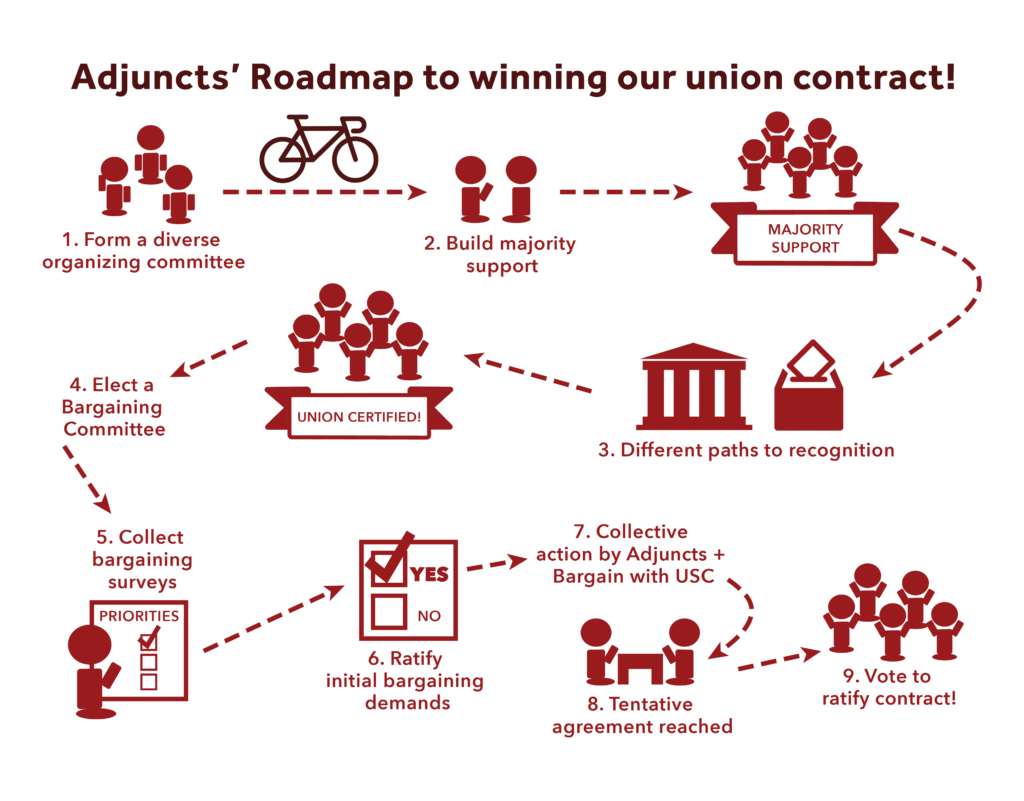
The first step is building strong support and securing recognition. A majority of USC SCA adjunct faculty have to sign a card to form a union, and we are continuing outreach to ensure that everyone has a chance to be heard and get involved. Strong majority support gives us more power to get our union recognized and begin the collective bargaining process.
Under collective bargaining in the UAW, faculty fill out bargaining surveys to articulate priorities for a contract. We also elect representatives, fellow adjunct faculty, to a bargaining committee. Guided by the feedback in the bargaining surveys, the elected committee develops bargaining goals that we vote to approve, before sitting down with the administration and negotiating contract proposals. Once a tentative agreement is reached, faculty must vote to accept or reject the contract before it goes into effect.
Thousands of graduate student workers at USC are currently bargaining a union contract with the USC administration and are also represented by UAW.
Did USC Faculty form a union in 2016 with SEIU?
In 2016, teaching-track faculty in Dornsife, Roski, and the International Academy voted on whether to form a union with SEIU. Faculty in Dornsife voted against forming a union, but the National Labor Relations Board (NLRB) determined that the USC administration interfered in the election and granted a redo. Faculty in Roski and the International Academy voted yes, but USC challenged the democratic decision by Roski faculty to form a union. USC claimed that full-time, part-time, and adjunct faculty were management and therefore did not have the right to form a union. Their challenge went to a federal court who ruled that the previous method of determining whether faculty were management or not was too broad. The court did not determine whether faculty actually were management. At that point, SEIU withdrew their petition to represent Roski and Dornsife faculty, which meant the NLRB did not hold another election for Dornsife faculty and the Roski faculty union was not recognized by USC.
Adjunct faculty perform the majority of teaching at USC. However, we do not participate in the management or governing of the university. We are coming together to form a union so we can have a real voice over our employment conditions. We reached out to UAW because they have a track record of success helping academic workers win union recognition and strong contracts. UAW already represents 3,000 graduate student employees at USC, who won their NLRB election with 93% support. USC did not challenge graduate students’ right to form a union and could choose to do the same with SCA adjunct faculty. We hope to build on the graduate students’ success by forming a union by, of, and for adjunct faculty.
What is the process of forming a union and bargaining a contract?
Here is the roadmap to forming a union:
Would I be included in the union?
Adjunct Faculty Alliance – United Auto Workers (AFA-UAW) seeks to include adjunct faculty who work at USC in the School of Cinematic Arts (SCA). We are adjuncts on renewable appointments from across SCA. International faculty have the same legal right to join a union as U.S. citizens. If you have a question about your eligibility or want to sign up, please contact us.
I am a faculty member outside of SCA. Will I be a part of the union?
While the current bargaining unit only covers adjuncts in SCA, we are excited to hear from other faculty members who are also interested in forming a union. Please reach out to info@adjunctfacultyalliance.
Can USC retaliate against me if I sign up in support of the union?
It is against the law for USC to retaliate against an employee for exercising the right to organize and participate in union activity. Thousands of USC graduate students have already organized with the UAW and are currently bargaining their first contract. Moreover, tens of thousands of academic workers have exercised union rights, including strikes, at campuses across the US from the University of California and the University of Washington to Columbia, Harvard, and the New School.
We already elect representatives to the Academic Senate. Why do we need a union?
SCA adjunct faculty are eligible to participate in committees throughout the school and university. Our elected representatives do excellent and important work, and reliably advocate for policies that would improve our working lives. However, adjunct faculty representatives can only make recommendations, and USC is free to ignore them. By contrast, with a union, USC is required by law to bargain in good faith with an elected adjunct faculty bargaining committee. Once the contract is ratified, it is legally binding and enforceable.
Why UAW?
UAW is the International Union of United Automobile, Aerospace and Agricultural Implement Workers of America (UAW). UAW has historically been one of the largest and most diverse unions in North America. In recent decades, 100,000 employees in higher education have joined, making UAW the single largest union of higher ed academic employees in the US. Academic employees from the University of California, Harvard, UConn, Columbia, University of Washington, and many more have found that joining UAW has allowed them to democratically determine priorities as a workforce and dramatically increase power to win improved rights and benefits through collective bargaining.
We reached out to UAW to help us successfully form a union at USC because it has expertise in bargaining under the National Labor Relations Act (the law which makes it possible to collectively bargain at private universities) and their track record of success. Additionally, graduate student workers at USC recently won their election to join the UAW and are currently negotiating with USC administration.We hope that by working together we can have a greater impact both at institutions of higher education and in society more generally.
What is the relationship between the AFA Organizing Committee (OC), Adjunct Faculty Alliance (AFA), and the United Auto Workers (UAW)?
The AFA Organizing Committee is working to build a union for USC adjunct faculty, assisted by UAW staff. When our union is recognized, Adjunct Faculty Alliance (AFA)-UAW will be the union for adjunct faculty at USC, affiliated with UAW. We will be part of a larger network of over 60,000 UAW academic workers in California, and more than 100,000 UAW academic workers across the U.S.
Will I have to pay dues?
Membership dues are important because they provide the resources necessary for effective representation. As part of the UAW, we would not pay dues until we have gone through the bargaining process and voted democratically to approve our first contract. Dues are critical for providing us with independent resources that are not controlled by the University: we use them to ensure we have appropriate legal, bargaining, community and staff support to represent adjuncts. UAW membership dues are currently 1.44% of gross monthly income and can only be increased by membership action (the membership in a few local unions, for example, have voted to increase dues above 1.44% to have more resources).
No one can be required to become a member of the Union after we have a contract. In most contracts, since everyone in the bargaining unit must receive all of the benefits of the contract, non-members are generally required to pay a comparable “fair share” fee, so the cost of representation is shared equally. The inclusion of a similar provision at USC would be something we decide as part of our bargaining agenda, would be subject to negotiation with USC administration, and contingent on ratification as part of our contract.
Many academic worker unions have such a provision in the contract because it means we have more power and more resources available to enforce our rights under our contract, campaign for the best possible future contracts, and help other academic workers form their own unions. Under the UAW, there is also a one-time initiation fee, which ranges from $10 to $50 and is determined democratically in local union bylaws approved by members.
The value of increased wages and benefits in the first contract typically outweighs the cost of dues, often leading to overwhelming majority approval of those agreements. For example, the highest paid Part-Time Faculty at the New School won a minimum raise of 9.85% for the 2022/2023 academic year, plus guaranteed increases in subsequent years.
What are dues used for?
Dues support a variety of resources that will give us the clout we need to effectively represent our members; these include educational, legal, negotiating, and other membership services. Dues also contribute to organizing new groups of workers, the strike fund, and political action. Right now, the dues of other UAW members are funding our organizing campaign.
Will we have to strike?
Striking is a powerful tool for workers to achieve our objectives. We would decide democratically whether or not to call a strike. Under the UAW constitution, a strike can only occur after a vote in which 2/3 of members voting authorize their elected representatives on the bargaining committee to call a strike.
Thousands of academic workers have democratically decided to go on strike in the past few years to win their demands. In 2022, Part Time Faculty at the New School authorized and went on strike until reaching an agreement with administration that significantly increased compensation, established professional development funds, and more. After many months of bargaining, Graduate Student Workers, Postdocs, and Academic Researchers at the University of California also went on strike and won some of the best contracts in higher education. Further, it is not uncommon for workers to decide that it is necessary to prepare for a possible strike in order to convince a university to reach a reasonable agreement during negotiations. In 2022, NYU adjunct faculty with ACT-UAW voted to authorize a strike, bringing the NYU administration back to the table and winning contract terms that set a new standard for part-time faculty nationwide.
Could USC adjunct faculty end up worse off with a union contract?
Under U.S. labor law, USC is required to bargain in good faith. This means that once our union is recognized, USC cannot make unilateral changes to the terms and conditions of our employment while bargaining is ongoing, or seek to alter the structure of our jobs. Bargaining begins from the status quo, and seeks to secure the terms and conditions of our employment in a legally-binding contract.
If I am an international faculty member, am I allowed to participate in the union?
Yes. International workers have the same legal right to join a union as American citizens. Visa requirements that international faculty members may only accept employment associated with the university sponsoring their visa in no way compromise the right to belong to a union that represents them in the workplace. No faculty member who is part of the UAW has reported any complications arising from the dual status of being both an international faculty member and a unionized employee.
Participation in political activities such as picketing, rallies, leafleting, and demonstrations, is protected under the Constitution for those residing in the U.S. on international workers visas, just as it is for U.S. citizens.
What do we have in common with Auto Workers?
Since its establishment in the mid-1930s, the UAW has been a dynamic, democratic organization representing a diverse array of workers, including tens of thousands of “white-collar workers” like technical writers, engineers, attorneys, administrative employees, academic workers, and others. In California, UAW members include workers at newspapers, nonprofits, and universities. Across the U.S., over 100,000 workers at universities are UAW members, and more are organizing on their campuses every day. We ARE the United Auto Workers.
As an increasingly significant part of the UAW, academic workers have joined in the union’s longstanding commitment to social justice to prioritize issues of importance to workers at U.S. universities such as civil rights, immigration reform, access to affordable and quality education, federal funding of innovative basic science research, healthcare reform, the right to collective bargaining, and many other issues.